What is Expense Ratio in Mutual Funds – And Why I Ignored It (Big Mistake)
A few years ago, I remember sitting across a friend at a small café after work. He had just started investing and looked genuinely excited. He said he have found a mutual fund which he is investing for long term, the returns are good in it also he said, he is putting all his savings into it.
I smiled and nodded. At that time, I thought I knew enough about investing too. Returns were everything, right? If a fund had performed well, it meant it was a good choice. Simple.
But there was something I didn’t pay attention to back then — something that seemed too small to matter. It was called the expense ratio. And ignoring it turned out to be a costly mistake.
This is something that many beginners overlook, not because they are careless, but because it’s rarely explained in a way that feels real. So let me walk you through it the way I learned it — through experience, not theory.
Understanding the Expense Ratio in Simple Terms
If you’ve ever invested in a mutual fund, you’ve probably seen a small percentage mentioned somewhere in the details. That percentage is the expense ratio. Always remember this, when you are investing your money in mutual funds, you are not the person who is managing the money. There’s a fund manager, a team of analysts, administrative staff, and operational costs involved. All of that costs money. The expense ratio is the fee you pay every year to cover those costs, so it will be expressed by the investment fund which you invested So if a fund has an expense ratio of 1.5%, it means 1.5% of your total investment gets deducted annually for managing the fund. At first glance, this doesn’t seem like a big deal. That’s exactly what I thought too.
Check this Link to join Assetplus to choose lower expense ratio – Click Here
Why I Ignored It — And Felt Smart About It
When I started investing, I focused only on returns. If one fund gave 14% returns and another gave 12%, my decision was obvious. I went with the higher number. I remember clearly choosing a fund that had fantastic past performance. It was popular, aggressively marketed, and everyone seemed to be recommending it. The expense ratio was around 2%, but honestly, I didn’t care.
My mindset was simple: “If it’s giving good returns, what difference does 1–2% even make?”
That’s the point where many investors unknowingly make the same mistake, because in investing, small percentages don’t stay small over time.
The Real Impact of Expense Ratio Over Time
A year passed. My investment had grown, and I was happy. But one day, while casually browsing through my account statement, I noticed something. The returns I saw in advertisements didn’t exactly match what I was getting.
That’s when I started digging deeper. Turns out, the returns that funds often highlight are gross returns — before expenses are deducted. What you actually receive is the return after the expense ratio is taken out.
Let’s simplify this.
Imagine your fund earns 12% annually, but the expense ratio is 2%. Your actual return becomes around 10%. It doesn’t sound dramatic, but the real difference appears when time comes into play.
Over 10 or 15 years, that “small” 2% can significantly reduce your overall wealth. It’s not just a one-time cut — it keeps eating into your returns every single year, that realization was a wake-up call.
A Personal Wake-Up Moment
I remember doing a rough calculation for my portfolio, If I had invested the same amount in a similar fund with a lower expense ratio — say 0.5% instead of 2% — my returns over the long term would have been noticeably higher. It wasn’t just about losing money. It was about losing potential.
That’s when I started feeling something investors rarely talk about — regret. Not because I made a bad choice, but because I made an uninformed one.
No one had explained this clearly when I started, and I never thought to question it either.
Why Expense Ratio Matters So Much
The truth is, expense ratio works silently. It doesn’t show up as a visible charge deducted from your bank account. You don’t get a notification saying, “We’ve deducted your annual fee.” Instead, it’s adjusted in the fund’s Net Asset Value (NAV).
That’s why many investors don’t realize how much they’re paying, but just because you don’t see it doesn’t mean it isn’t affecting you. Think of expense ratio like a small leak in a bucket. One drop doesn’t matter. But over time, it slowly drains what you’ve worked hard to fill and in long-term investing, every percentage counts more than you think.
The Lesson I Learned (The Hard Way)
After that realization, I didn’t panic or sell everything immediately. What I did instead was shift my mindset.
I stopped chasing only high returns and started asking better questions: Is this fund delivering returns consistent with its cost? Are there similar funds with lower expense ratios? Am I paying more than necessary for the same kind of performance?
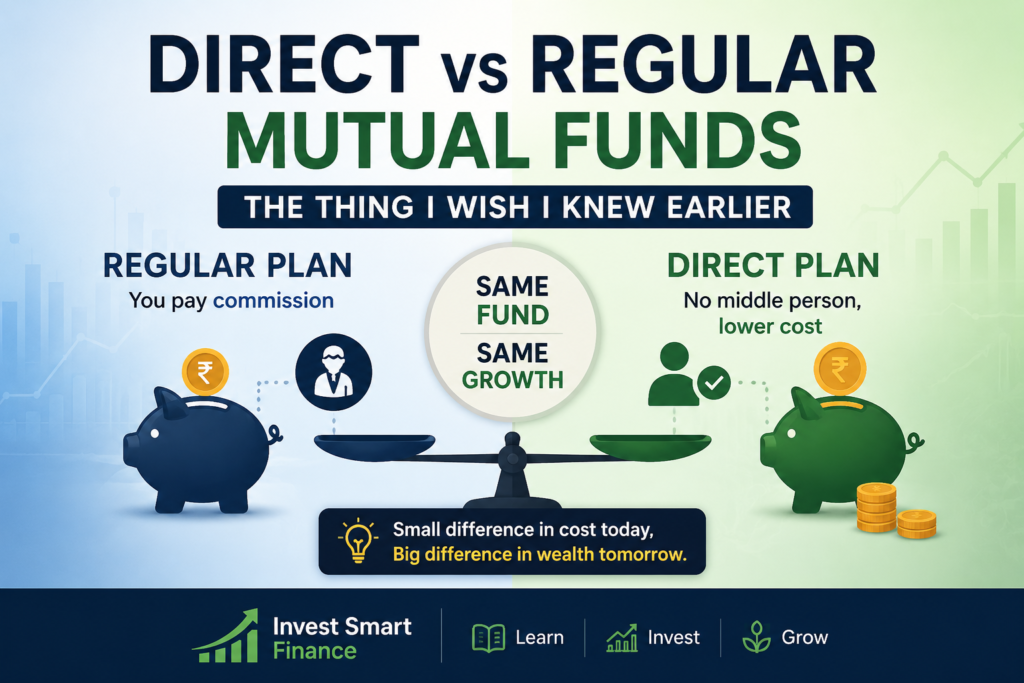
This simple change made a big difference.I started exploring index funds and direct plans, which usually have lower expense ratios compared to actively managed funds and regular plans. And slowly, I began optimizing my portfolio, not just for returns, but for efficiency.
What Beginners Should Keep in Mind
If you’re just starting your investment journey, it’s completely normal to feel overwhelmed. There are too many terms, too many options, and too much information, But if there’s one thing I’d strongly suggest, it’s this: don’t ignore the expense ratio.
Just be aware that every percentage you pay has an impact on your long-term wealth. A fund with slightly lower returns but a significantly lower expense ratio can sometimes outperform a high-return, high-cost fund over time.
If a fund is charging more, it should justify that cost with consistently better performance. If it doesn’t, there’s no reason to stick with it.
A Quiet but Powerful Factor in Investing
Looking back, I don’t see my mistake as something terrible. In fact, it taught me one of the most important lessons in investing. Not all costs are visible. And not all mistakes feel like mistakes immediately. The expense ratio is one of those quiet factors that doesn’t demand attention but deserves it.
Today, whenever I talk to someone new to investing — whether it’s a colleague, friend, or even a family member — I make sure to mention this one thing, Because if someone had told me earlier, I could have avoided learning it the hard way.
Final Thoughts
The expense ratio might seem like a small detail at first, but over time, it plays a much bigger role than most people realize. If you’re building your wealth for the future, every decision matters — even the ones that look insignificant. I once ignored the expense ratio because it didn’t feel important.
Today, I know that sometimes, the smallest details are the ones that shape your financial journey the most.
Author
I am Livin Rangasamy, an Author, Engineer, AMFI ( Association of mutual funds in India) registered Mutual fund distributor and a guy who is more interested to teach finance to people who are interested.
Disclaimer
This content is meant for general understanding only and should not be taken as financial advice. It’s always better to do your own research or consult a professional before investing.
For More similar Posts: – Click Here